Before anything else
The equipment matters far less than the programme
A gym with two racks, a set of dumbbells and a coach who writes a progressive programme will produce better results than a gym with two hundred machines and nobody paying attention. Every piece of equipment below is a tool for applying a stimulus; what decides whether you adapt to it is how much, how often, how it progresses and whether you recover. Choose the programme first. The equipment is how it gets delivered, not what makes it work.
Everything, if you learn it · Load: very high · learning curve: Weeks, not minutes
The barbell
Best for
Building genuine strength, and the single most efficient tool in the building for it.
What is good about it
Nothing else lets you add two and a half pounds a week for a year. A bar can be loaded from 45 lb to more than you will ever lift, the movements are identical whether you are a beginner or a competitor, and progress is measured in numbers rather than in how a session felt. If you only ever learn five things here, learn the squat, the hinge, the press, the row and the carry.
What to watch
It is also the tool with the longest learning curve and the least forgiving technique. A badly coached barbell squat will hurt you where a badly used leg press mostly will not. This is why we will keep a beginner on an empty bar for three weeks and why it is never presented as an insult.
Upper body, single-leg, core · Load: high · learning curve: One session
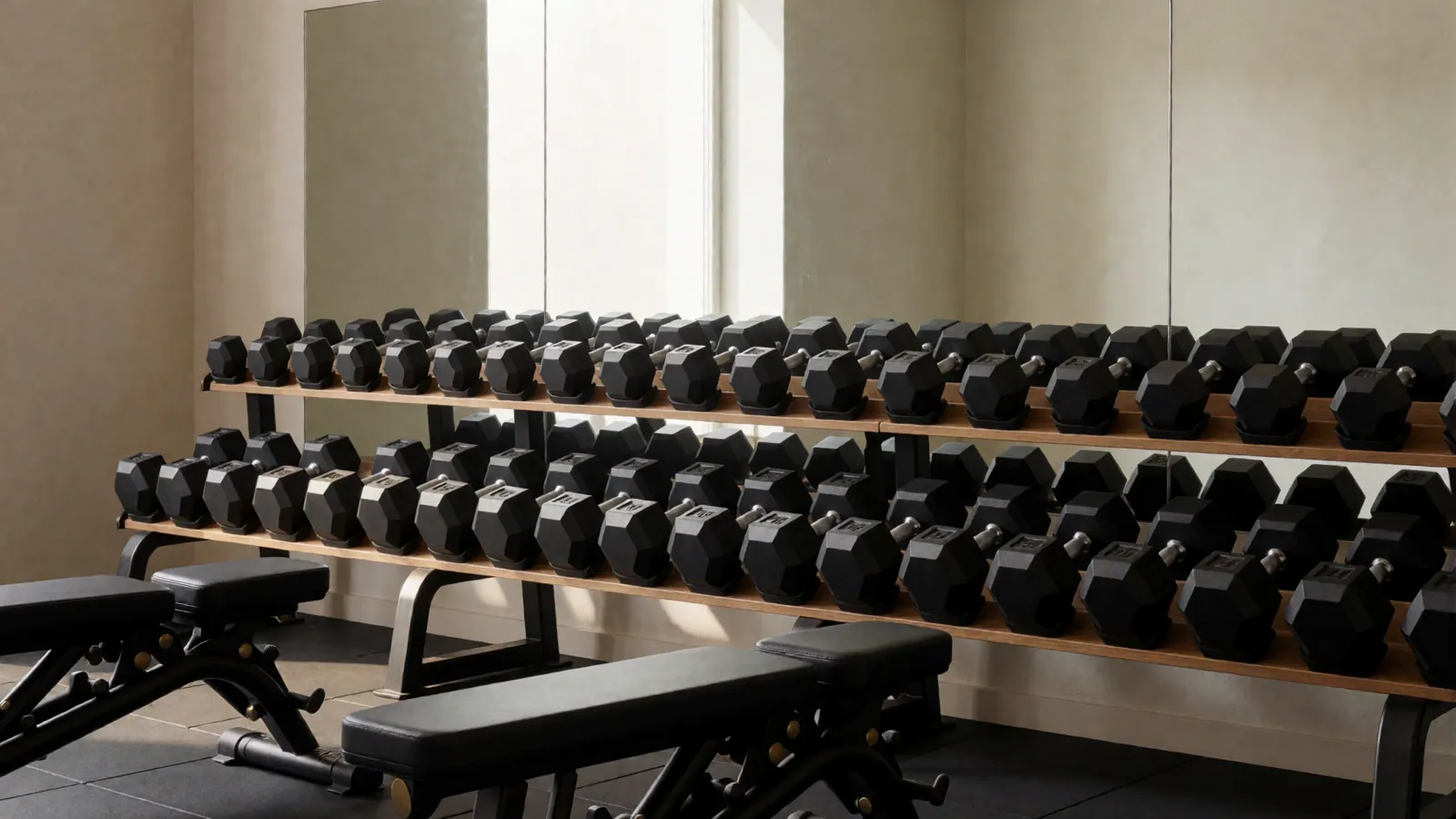
Dumbbells
Best for
Almost everybody, almost always — and especially anyone with a side that is noticeably weaker than the other.
What is good about it
Each arm and each leg has to do its own work, which is how a left-right imbalance gets found and fixed. The range of motion is larger than a machine's, the joint path is yours rather than the engineer's, and the learning curve is short enough that a first-week member can use them well.
What to watch
Our set runs to 130 lb in 5 lb steps, which most gyms quietly truncate at 75. The other trap is ego: a dumbbell press you cannot control on the way down is not a heavier lift, it is a shoulder injury with a longer runway.
Hips, grip, conditioning · Load: moderate to high · learning curve: Two or three sessions
Kettlebells
Best for
Conditioning that is not running, and teaching a hip hinge to somebody who cannot feel one.
What is good about it
The offset handle turns a swing into a hip drill that people feel immediately, in a way a barbell deadlift often does not click for weeks. Swings, goblet squats, carries and get-ups cover an enormous amount of ground with one implement, and a heavy carry is the most underrated exercise in this building.
What to watch
A swing is a hip movement and not a squat or an arm raise, and taught wrong it becomes a lower-back exercise very quickly. We teach the hinge with a dowel first. Nobody swings a bell here in their first session, and that is not us being precious.
Squat, press, pull-up, rack pull · Load: very high · learning curve: One orientation
The power rack
Best for
Anybody lifting heavy alone, which by the evening is most of the floor.
What is good about it
Adjustable safety arms mean you can fail a squat or a bench press safely without a spotter, which is what makes solo heavy training possible at all. Ours are competition height with pull-up bars, dip attachments and enough depth that you are not stepping out of the rack to press.
What to watch
Set the safeties before the set, not after the first rep — at the height where the bar would rest if you failed at the bottom, which is lower than most people guess. Ask a coach once and you will never need to ask again.
Upper back, shoulders, core · Load: moderate · learning curve: One session
Cable machines
Best for
Filling the gaps a barbell leaves, and training rotation and anti-rotation properly.
What is good about it
Constant tension through the whole range and a resistance line you choose rather than one gravity chooses for you. Face pulls, rows, pallof presses and woodchops are difficult to replicate with free weights, and they are exactly the movements that keep shoulders and lower backs healthy in people who lift heavy.
What to watch
Easy to use badly because they are so forgiving. Momentum will do the work if you let it, and a cable exercise done with a swinging torso trains almost nothing. Slower than you think, and lighter than you think.
Full body conditioning · Impact: very low · learning curve: One coaching session
The rowing machine
Best for
Anybody whose knees, hips or shins object to running, and anybody who wants hard conditioning in fifteen minutes.
What is good about it
It is a full-body effort with almost no joint impact, it scales from a gentle warm-up to the hardest ten minutes available in this building, and it gives you an honest number every single time. Twenty minutes of steady rowing is one of the most useful things a desk worker can do.
What to watch
Nearly everybody rows arms-first, which is backwards and is why their lower back hurts afterwards. The sequence is legs, then back, then arms, and reversed on the way in. Five minutes of coaching fixes it permanently — ask, because you will not spot it yourself.
Cardiovascular base, sprinting · Impact: moderate to high · learning curve: None
Treadmills and curved treadmills
Best for
Building an aerobic base, and sprint work in January when 61st Street is ice.
What is good about it
The most familiar machine in any gym and still one of the most useful. Ours have proper cushioned decks, and the two curved manual treadmills are self-powered — they run at exactly the speed you run, which makes them superb for intervals and nearly impossible to cheat on.
What to watch
Running is a high-impact activity and a treadmill does not change that. If you are new, heavy, or coming back from a lower-limb injury, start on the bike or the rower and earn your way onto this. Holding the handrails while walking on a steep incline is also, biomechanically, not exercise.
Cardiovascular base, legs · Impact: very low · learning curve: One setup
Indoor bikes
Best for
Beginners, heavier members, anybody managing a knee or ankle, and anybody who wants to work very hard safely.
What is good about it
Almost no impact, an effort you control entirely, and a seat position that once set correctly is correct forever. It is the safest way in the building to reach a genuinely high heart rate, which is why we start most deconditioned members here.
What to watch
A saddle at the wrong height is the cause of essentially every knee complaint we hear about cycling, and the correct height is higher than most people set it. Have a coach set yours once — it takes ninety seconds and it is written on your record afterwards.
Legs, conditioning, work capacity · Impact: low, effort: brutal · learning curve: One session
The sled and the turf lane
Best for
Conditioning for people who should not be running, and building leg strength that carries into a sport.
What is good about it
A sled has no eccentric phase at all — nothing lowers under load — so it produces very little muscle soreness for a very large amount of work. That combination makes it the single best conditioning tool for somebody with a joint history, and it is also just extremely hard, which some people want.
What to watch
Hard to overdo technically, easy to overdo in volume. Four heavy lengths of the turf will affect your next two days more than you expect the first time. Start with half what you think.
Upper body, core, scaling · Load: bodyweight · learning curve: One session
Suspension straps and rings
Best for
Anyone between a knee push-up and a full one, and anyone working toward a first pull-up.
What is good about it
You change the difficulty by changing your body angle, so the same two straps give you fifty gradations of a row or a push-up. That makes them the best bridging tool we have for beginners, and rings remain genuinely difficult for advanced trainees on the same apparatus.
What to watch
Set the anchor and the strap length before you load them, and keep your body in one line rather than folding at the hips. Straps also punish a shoulder that is not ready — if a movement pinches at the front of the shoulder, stop and ask.
Deep core, control, mobility · Impact: very low · learning curve: Two or three sessions
The reformer
Best for
Post-rehab work, postnatal training, and lifters whose control has not kept up with their strength.
What is good about it
Spring resistance supports as much as it loads, which is why a reformer can train somebody who cannot yet hold their own bodyweight and still challenge somebody who deadlifts three times theirs. It is unmatched for control, breathing and end-range strength — the qualities that keep the heavy stuff safe.
What to watch
It is not a substitute for strength training, whatever anyone tells you. It builds control and range, and it is best used alongside a barbell rather than instead of one. Classes are capped at eight because we have eight reformers.
Recovery, heat and cold tolerance · Recovery · learning curve: None
The sauna and the cold plunge
Best for
Ending a hard session, a stiff week, or a January evening.
What is good about it
Heat helps most people relax and sleep, cold is a genuinely effective way to feel better quickly, and the ten minutes you spend in either is ten minutes you are not looking at a phone. Regular sauna use has a decent evidence base for cardiovascular health, which is more than can be said for most recovery gadgets.
What to watch
Cold water immediately after resistance training may blunt some of the adaptation you just paid for, so if you are chasing strength or muscle, plunge on rest days or several hours later. Do not use either if you are pregnant, have a cardiac condition, or have been drinking — and never use the plunge alone in the building.
Putting it together
What we would actually put you on, and when
A complete beginner, two days a week
Dumbbells, a bike or rower, and the goblet squat. Barbells come in around week three once the pattern is sound. The first block has five exercises in it and that is deliberate — a beginner improves on almost anything, so the only thing that matters is that they can repeat it next week.
Somebody who wants to be genuinely strong
The barbell, in a rack, three days a week, with dumbbells and cables for accessory work and a sled for conditioning. There is no substitute and there is no shortcut. It takes years and it is worth them.
A desk worker with forty minutes and a stiff back
Cables for face pulls and rows, kettlebells for the hip hinge, a loaded carry, and ten minutes of thoracic and hip work. The rowing machine for conditioning, because it is the opposite shape from sitting.
Anybody who cannot run
The bike, the rower and the sled. Between them you can reach any conditioning intensity you like with essentially no joint impact, which is why this is where most of our post-rehab members do their cardiovascular work.
An adult over sixty
Dumbbells, a leg press or box squat, loaded carries, step-ups, and medicine-ball throws for power. Grip and single-leg balance measured at every retest, because those are the numbers that actually predict independence.
Somebody returning from injury
The reformer, resistance bands and the backward sled drag, inside written restrictions, with Priya deciding what comes off the list and when. Not the barbell, and not yet.
Nobody should have to guess
Two coached orientations come with every membership
A coach walks you through every floor and shows you how each thing works — including the ones you would never have touched. Nobody trains a movement here they have not been shown, and Open Coaching Hour runs twice a week for anything you missed.