Not sure where to start? The ninety-minute assessment is free, involves nothing to sign, and ends with a written twelve-week programme you keep whether or not you join. Call 000-000-0000
Almost everything genuinely functional is unglamorous. Carrying heavy things. Pushing heavy things. Picking heavy things up off the floor. Getting up off the ground. Moving quickly in a direction you did not plan on. None of it involves standing on one leg on a wobbly cushion, which is what the word has too often come to mean.
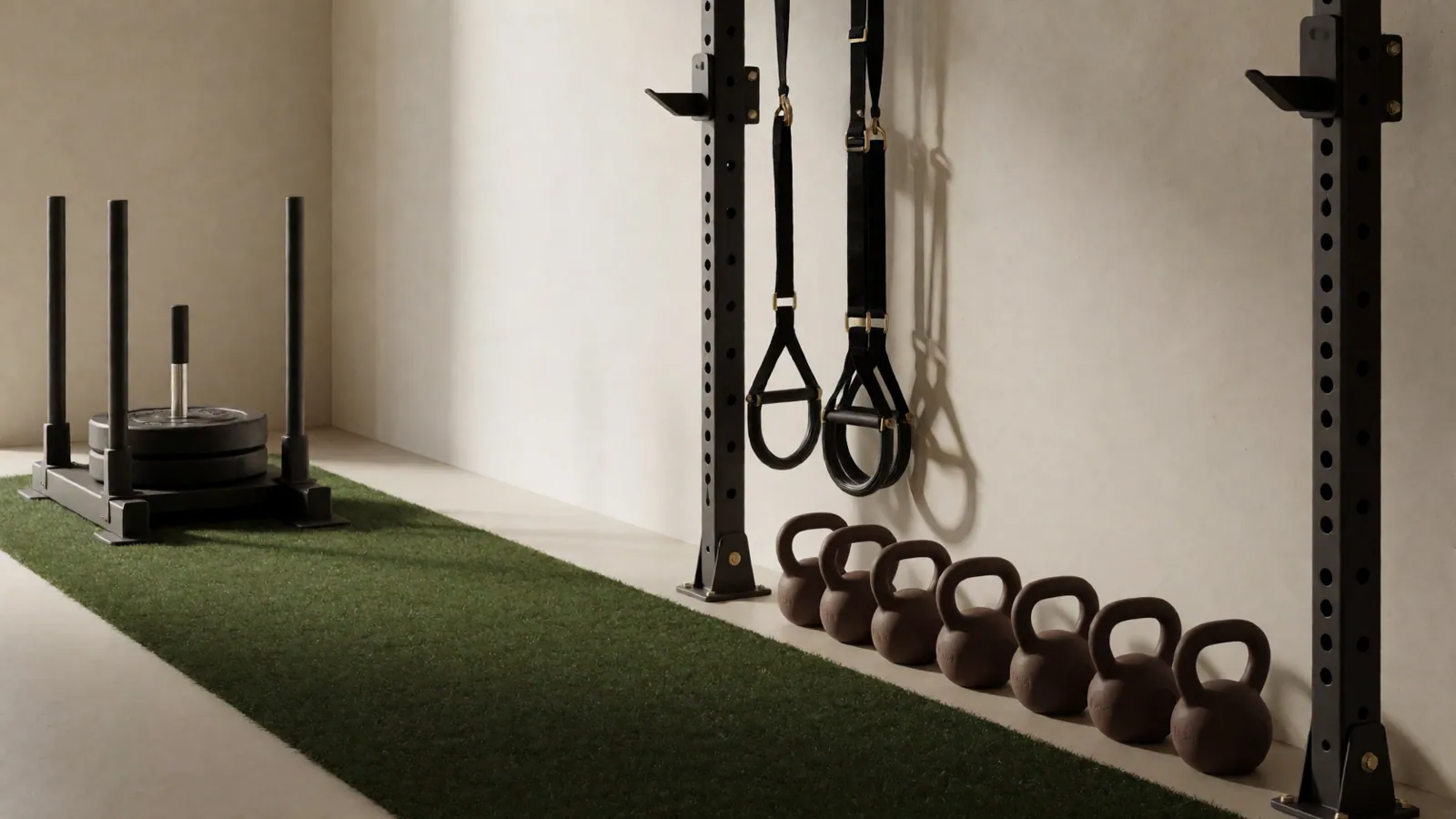
The functional zone is where this lives — a forty-foot turf lane for sleds and carries, a twelve-station rig with rings and suspension straps, kettlebells from eight to forty-eight kilos, medicine balls, ropes and boxes. It is also where the sports performance and youth sessions happen, because the tools overlap almost completely.
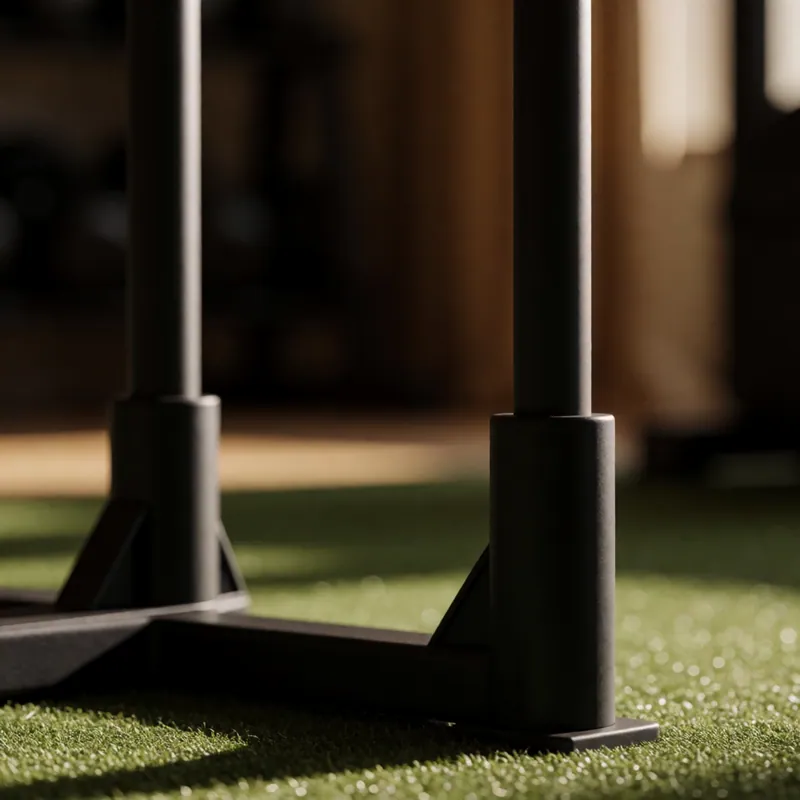
The sled deserves particular mention. Because nothing lowers under load, a sled produces almost no muscle soreness for an enormous amount of work — which makes it the single best conditioning tool available to anybody managing a joint, anybody who cannot run, and anybody who has to be functional at work tomorrow. It is also, straightforwardly, extremely hard.
What lives in the functional zone
Chosen because each one does something the barbell floor cannot.
The sled
Push and drag, forward and backward. No eccentric loading at all, which means enormous work with minimal soreness. Backward drags are also one of the best-tolerated knee exercises we have.
Loaded carries
Farmer's, suitcase, front-rack and overhead. Grip, trunk, hips and balance in one exercise, and the most direct transfer to ordinary life of anything in the building.
Kettlebells
Swings, goblet squats, get-ups and carries. The offset handle teaches a hip hinge in a way that people feel immediately, which is why they appear in almost every beginner's first month.
The rig, rings and straps
Body-weight work scaled by angle rather than by load — rows, push-ups, dips and pull-up progressions. The best bridging tool we have for anyone between a knee push-up and a full one.
Medicine balls
Throws and slams, which train rate of force development in a way that is difficult to reproduce with weights you have to decelerate. Particularly useful for older adults, where power fades before strength.
Boxes and the turf
Step-ups, jumps and landings. Landing mechanics is the most transferable injury-prevention skill available and is taught almost nowhere.
What 'functional' should actually mean
A short list of what is real and what is marketing, since this word has been abused more than any other in the industry.
Real: loaded carries and sleds
Directly transferable, extremely well tolerated, and hard to do badly. Almost every member here does both regardless of their goal.
Real: getting up off the floor
Turkish get-ups and their simpler variations. It is a genuine skill, it degrades with age, and practising it is the difference between a fall being an embarrassment and a hospital admission.
Real: single-leg work
Nearly everything you do outside a gym happens on one leg. Split squats, step-ups and single-leg deadlifts find asymmetries that a barbell hides completely.
Marketing: unstable surfaces
Squatting on a wobble board makes the squat worse without making your balance better. Balance is trained on the ground, on one leg, with load.
Marketing: exercises that mimic a job
Training the pattern under load is what transfers. Miming a specific movement with a light weight and a cable does not, and it usually trains the pattern badly.
The honest summary
Get strong at the five patterns, carry heavy things, work on one leg, and learn to land. That is functional training. It takes about forty minutes and no gadgets.
Who spends most time in this zone
It is used by almost everybody, and by these groups particularly.
People who cannot run
Sleds and carries deliver hard conditioning with essentially no impact. This is where Priya sends most post-rehab members for their conditioning work.
Trades and physical workers
Woodside has a lot of them. Carrying capacity, grip and a back that tolerates load are the things that keep somebody working, and they are trained here rather than on a machine.
Young athletes
Devon runs the youth sessions on the turf. Sprint mechanics, deceleration, landing and sled work make up most of what a teenage athlete actually needs.
Older adults
Get-ups, carries, step-ups and medicine-ball throws map directly onto independence. Power work matters more with age, not less, and it is trained here.
Lifters who need conditioning
Sled work and carries produce far less interference with heavy lifting than running does, which makes them the sensible conditioning choice for anyone chasing strength.
Functional Fitness in western Queens
Sleds, carries, rigs and turf — training that transfers directly to the things you do outside this building.
It starts the same way whatever you are here for: ninety minutes with a coach, a movement screen, a handful of baseline numbers, and a written twelve-week programme in your hand at the end of it. The assessment is free, the programme is yours to keep, and there is nothing to sign.
Questions
Functional Fitness — the questions we are asked most
What is functional training, exactly?
Training the movement patterns you actually use — squatting, hinging, pushing, pulling, carrying, and getting up off the floor — under load, in positions you actually use them. It is not balance boards, unstable surfaces, or exercises that mime a specific job with a light cable. Load and pattern are what transfer; novelty is not.
Is a sled workout harder than running?
Different, and often harder for a given duration. The important difference is that a sled has no eccentric phase — nothing lowers under load — so it produces very little muscle soreness for a very large amount of work. Four heavy lengths of our turf will affect your next two days more than you expect the first time.
Can I do this if I cannot run?
Yes, and it is precisely why the zone exists. Sled pushes, drags, carries and kettlebell work give you genuinely hard conditioning with essentially no impact. This is where most of our post-rehab and joint-managing members do their cardiovascular work.
Are kettlebells safe for beginners?
Coached, yes. The swing is a hip movement rather than a squat or an arm raise, and taught wrongly it becomes a lower-back exercise very quickly. We teach the hinge with a dowel first and nobody swings a bell in their first session — that is not us being precious, it is the difference between a great tool and a sore back.
Do I need to be fit to use the functional zone?
No. Sleds, carries and rig work are among the most scalable things in the building — an empty sled and a five-pound carry are both perfectly legitimate starting points, and the rig scales by body angle rather than by load. Your orientation covers all of it.
What is a loaded carry and why does everyone here talk about them?
Picking up something heavy and walking with it. It trains grip, trunk, hips and balance simultaneously, it is almost impossible to do with bad technique, and it transfers directly to shopping, suitcases, children and work. Pound for pound it is the most useful exercise in this building.
Can I book the turf lane?
It is first come, first served during open hours, and it is reserved for coached sessions at the times shown on the timetable — mainly Thursday and Friday afternoons for youth athletics. If it is free, it is yours.
Is this the same as competitive functional fitness?
No. We use some of the same equipment, and the programming philosophy is different: our sessions are progressive within a six-week block rather than maximally hard every day, and there are no timed high-repetition Olympic lifts. If the competitive version of functional fitness is what you want, we will point you at a gym that specialises in it. We do not name any particular brand or franchise — you will not find one anywhere on this site.
Related
Members usually pair this with
Strength & Performance
Strength Training
Ten platforms, calibrated plates, and a programme where the numbers go up on purpose rather than by accident.
Read more
Strength & Performance
Sports Performance
Speed, power and durability for competitive athletes, periodised around your actual season.
Read more
Strength & Performance
Weight Loss Coaching
Strength training, a nutrition conversation with a registered dietitian, and no meal plan you cannot cook.
Read moreFree assessment, free trial week, no contract
Book a free 90-minute assessment
Ninety minutes with a coach, nothing to sign, and a written twelve-week programme you keep whether or not you join. Every membership is month to month with no initiation fee and no notice period, and the trial week is free.