
Not sure where to start? The ninety-minute assessment is free, involves nothing to sign, and ends with a written twelve-week programme you keep whether or not you join. Call 000-000-0000
Anybody can call themselves a nutritionist in most of the United States. A registered dietitian nutritionist has completed an accredited degree, a supervised practice programme and a national examination, and is licensed and accountable. It is the difference between somebody qualified to work alongside your physician and somebody who has watched a lot of videos, and in a field this full of confident nonsense it is worth knowing which you are speaking to.
Elena's approach is deliberately unexciting. She starts with sleep, because short sleep reliably makes people hungrier and reduces the proportion of any weight lost that is fat rather than muscle. Then daily movement. Then protein. Most people need nothing beyond those three for the first several months, and being told so is often a relief.
She also does not sell anything. There is no supplement shelf in this building and no coach here earns a cent from one. Where something is genuinely useful — creatine, vitamin D in a New York winter, a protein powder if hitting protein by food alone is impractical — she will name it and tell you where to buy it cheaply, which is generally the supermarket.
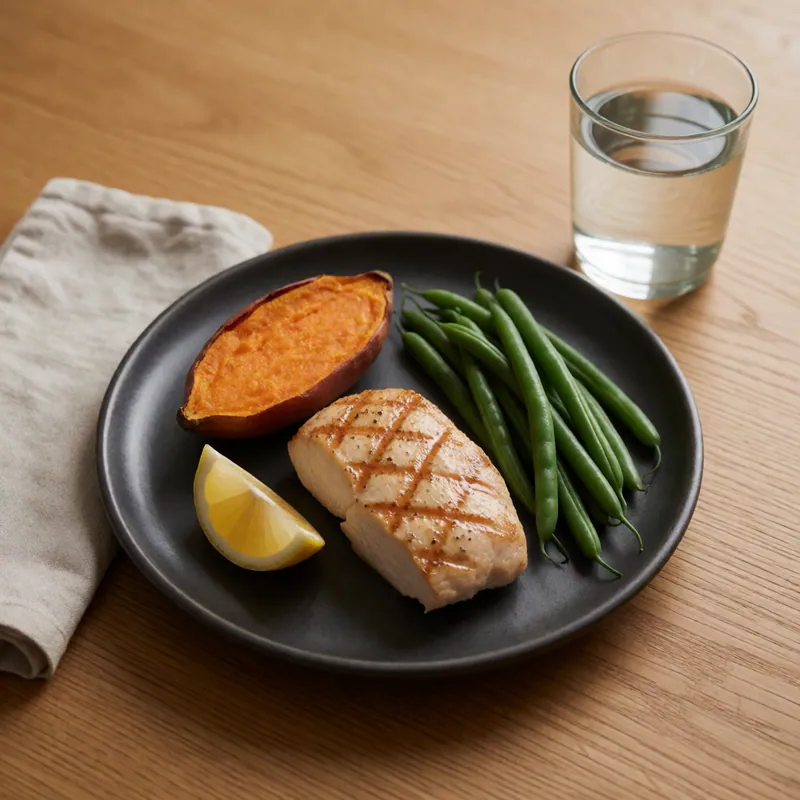
What nutrition coaching involves
A conversation and a plan, revisited monthly. Not a diet, and not a spreadsheet you will stop filling in by week three.
A full intake, first
What you eat, when, who you cook for, what you can afford, what your kitchen and your schedule actually allow, and any medical history or medication that matters. It takes an hour and it is the part that makes the rest work.
Sleep and steps before food
Almost always the first two interventions, because they are the largest levers and neither requires you to change what you eat. People are frequently annoyed by this and almost always grateful three months later.
Protein at every meal
The single change that helps the widest range of people — satiating, muscle-sparing, and it requires removing nothing. Often the only dietary change made for months.
Structure rather than prescription
A framework for building meals from food you already buy and already like, rather than a list of meals to follow. Plans get abandoned; frameworks survive a holiday.
Monthly review and adjustment
Sixty minutes, in a private room, with the actual data — weight trend, training log, how the last month went. Adjustments are small and evidence-led.
Referral where it is warranted
Elena is trained to recognise disordered eating, and where a pattern warrants clinical care she will say so and refer. That is what a licensed credential is for.
What we do not do
Each of these is standard practice somewhere in this industry, and each of them is a reason to be careful.
No supplements sold or commissioned
There is no shelf and no coach earns anything. A gym that sells supplements has a financial interest in you believing you need them, and that interest sits between you and honest advice.
No meal plans
A plan built around ingredients you do not like, cannot find nearby or have no time to prepare is a plan you abandon in week two. We work with how you actually shop and cook.
No forbidden foods and no cheat days
Both framings turn eating into a moral question, and that is where a great deal of disordered eating begins. Nothing here is off limits and nothing needs to be earned.
No detoxes, cleanses or elimination without cause
Your liver and kidneys perform detoxification continuously and unaided. Elimination diets have real clinical uses and are not a general-purpose intervention.
No body-fat photographs
Body composition is measured in a private room if you want it, and nobody is photographed. Progress photographs help some people and harm others, and it should be your decision rather than our marketing.
No claims about specific results by a specific date
Anybody guaranteeing a number and a deadline is guessing, and guessing in a direction that sells.
The questions Elena is asked most
Short answers to the things that take up most of the first session.
'Do I need to count calories?'
Not necessarily, and for many people it is counterproductive. Portion structure, protein at each meal and consistent timing achieve the same thing for most people. Counting is a useful tool for a defined period, not a permanent state.
'Are carbohydrates bad?'
No. Total energy and protein intake determine almost everything about body composition; the split of the remainder between fat and carbohydrate matters far less than any of the popular accounts suggest, and much less than whether you enjoy the food enough to keep eating it.
'Should I take protein powder?'
Only if hitting your protein by food alone is impractical, which for some people it genuinely is. It is food in a convenient form and nothing more. Buy the cheapest one that dissolves properly.
'What about intermittent fasting?'
It works for people it suits, because it makes eating less easier for them — and it has no meaningful metabolic advantage over the same intake spread differently. If skipping breakfast makes your day easier, do it. If it makes you ravenous at four, do not.
'Is creatine safe?'
It is one of the most studied supplements in existence with a strong safety record in healthy adults, and it is inexpensive. It is also completely optional. Elena will tell you which supermarket sells it cheapest and will not sell it to you.
'Why has my weight gone up this week?'
Water. Sodium, carbohydrate intake, training volume, the menstrual cycle and stress all move scale weight by several pounds within a day, and none of it is fat. This is why we look at trends over a fortnight rather than at any single morning.
Nutrition Coaching in western Queens
A registered dietitian, no supplements for sale, and no plan built around food you will not cook.
It starts the same way whatever you are here for: ninety minutes with a coach, a movement screen, a handful of baseline numbers, and a written twelve-week programme in your hand at the end of it. The assessment is free, the programme is yours to keep, and there is nothing to sign.

This page is general information, not medical advice. Nothing here is a diagnosis, a treatment plan or a substitute for your own physician, physical therapist or registered dietitian. If you have a cardiac condition, uncontrolled blood pressure, a recent surgery, a current injury, an eating disorder or a pregnancy, speak to your provider before starting or changing a training or nutrition programme — and tell us what they say, because we build around written clearance rather than around what somebody remembers being told. Pain at rest, pain that wakes you at night, worsening symptoms or any neurological symptom need proper clinical assessment first, and we will say so rather than train through them.
Questions
Nutrition Coaching — the questions we are asked most
What is the difference between a dietitian and a nutritionist?
In most of the United States, 'nutritionist' is an unprotected title anybody may use. A registered dietitian nutritionist has completed an accredited degree, a supervised practice programme and a national examination, and is licensed and accountable. Elena holds the second. In a field this full of confident claims, the distinction matters.
Do you sell supplements?
No. There is no supplement shelf in this building and no coach earns anything from one. Where something is genuinely useful, Elena will name it and tell you where to buy it cheaply — usually a supermarket. A gym that sells supplements has a financial interest in you believing you need them.
Will you give me a meal plan?
No, deliberately. Meal plans built around ingredients you do not like, cannot find locally or have no time to cook get abandoned inside a fortnight. You get a framework for building meals from food you already buy, which survives a holiday, a night shift and a bad week.
Do I have to count calories?
Not necessarily, and for a good number of people it is counterproductive. Portion structure, protein at every meal and consistent timing get most people where they need to be. Counting is a useful tool for a defined period rather than a permanent way of living.
Can you help with a medical condition?
Elena is a licensed clinical practitioner and can work alongside your physician on conditions with a dietary component. What she will not do is work around your physician — for anything under active medical management we ask to be in contact with the treating clinician, with your consent.
What if I have a difficult relationship with food?
Say so at the intake. Elena is trained to recognise disordered eating patterns and will adjust the approach or refer you to appropriate clinical care. We do not use forbidden foods, cheat days, progress photographs or before-and-after marketing, partly for exactly this reason.
How much does nutrition coaching cost?
Ongoing coaching is $140 a month for a monthly session plus written guidance and messaging, or $295 a month bundled with the Coached membership. A single consultation is $120 and a follow-up is $85. Coached members get a nutrition starter session included once a year.
Do I need to be a member?
No. Nutrition coaching is available to non-members at the same rates, in person or by video call. Plenty of Elena's clients train somewhere else entirely, or nowhere at all.
Related
Members usually pair this with

Wellness & Recovery
Post-Rehab Training
The gap between your last physical therapy appointment and training normally, bridged in writing.
Read more
Wellness & Recovery
Recovery & Sauna
A cedar sauna, a cold plunge held near fifty degrees, and honest guidance about when each one helps.
Read more
Wellness & Recovery
Corporate Wellness
Coached sessions for local teams, scheduled inside the working day where attendance actually holds up.
Read moreFree assessment, free trial week, no contract
Book a free 90-minute assessment
Ninety minutes with a coach, nothing to sign, and a written twelve-week programme you keep whether or not you join. Every membership is month to month with no initiation fee and no notice period, and the trial week is free.