Not sure where to start? The ninety-minute assessment is free, involves nothing to sign, and ends with a written twelve-week programme you keep whether or not you join. Call 000-000-0000
Physical therapy ends when you are functional, not when you are strong. A repaired rotator cuff that has been discharged is usually cleared to lift a bag of groceries and nowhere near ready for an overhead press — and the sheet you were given does not explain how to get from one to the other. Most people either stop entirely or go back to what they were doing before, and a meaningful share of them get hurt again.
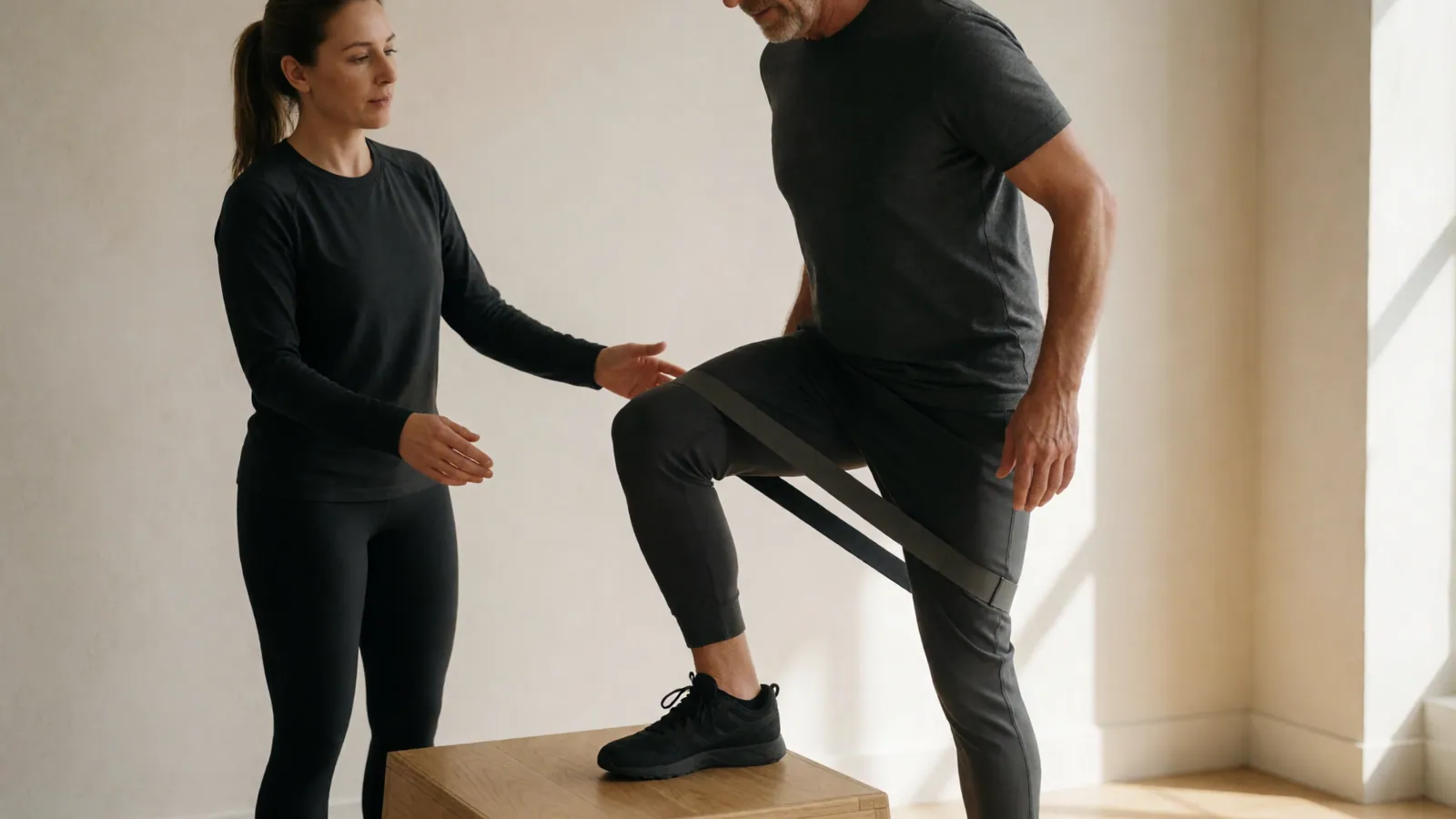
Priya is a licensed physical therapist who works on this floor rather than in a clinic. She takes every post-rehab referral, obtains the restrictions in writing from your treating therapist wherever we can, and builds the programme inside them explicitly rather than by inference. If a restriction is unclear she will call and ask rather than guess.
We are careful about the boundary. We are not treating you — if you are still symptomatic, still under active care, or the problem is getting worse, you need a clinician and not a gym, and Priya will tell you so plainly. What we do is the strength and conditioning work that comes after treatment, which is a different job and a genuinely under-served one.
How a post-rehab case runs
Deliberately slow at the start. Almost everybody wants to skip the first four weeks and almost nobody should.
A private screen, before anything else
Sixty minutes with Priya. Your history, your imaging and therapy notes, and a movement assessment focused on the affected region and everything it compensates with — which is usually the more interesting half.
Restrictions obtained in writing
From your treating therapist or surgeon wherever possible, with your consent. Written restrictions are unambiguous; remembered ones are not, and 'she said to be careful with it' is not a programme input.
A written programme with the limits stated on it
The restrictions appear on the document itself, so any coach who ever works with you can see them. This is why we write them down rather than relying on somebody's memory of a conversation.
Load introduced very gradually
Usually starting well below what you feel capable of. The tissue's tolerance is what limits you, not your enthusiasm, and tendon in particular adapts on a slower timescale than muscle.
Progress reviewed every two weeks
More often than a normal programme, because the tolerance changes faster and the consequences of getting it wrong are larger.
A defined exit
The point at which you are simply a member training normally. Most people reach it between four and nine months and it is a genuine milestone rather than a soft transition.
What we see most often
The five most common referrals through this door, and what the work actually looks like.
Shoulder — rotator cuff repair or impingement
Scapular control first, then range, then load, then overhead. Overhead pressing is usually the last thing restored and is frequently four to six months away. The unaffected shoulder almost always improves as well.
Knee — ACL reconstruction or meniscus
Quadriceps strength and single-leg control are the whole game, and the deficit is usually far larger than people believe at discharge. Backward sled drags are unusually well tolerated and are in almost every one of these programmes.
Lower back — disc or persistent pain
Hip extension, trunk endurance and re-learning to hinge without fear. Frequently the most rewarding case type, because people arrive expecting to be told to avoid things and instead get progressively loaded.
Hip and knee replacement
Restrictions differ by surgeon and by surgical approach, so we work from your surgeon's guidance rather than a general rule. Progress is usually faster than people expect once the first six weeks are behind them.
Ankle — sprain, fracture or achilles
Dorsiflexion range, calf strength through a full range, and balance. The most under-rehabilitated joint in the body — most ankle sprains are never rehabilitated at all, which is why the second one happens.
The boundary we keep
Written plainly because it matters and because being vague about it would be worse for you.
We are not treating you
This is strength and conditioning after treatment, not treatment. Priya's clinical licence informs how carefully we build the programme; it does not turn this into a clinic.
Still symptomatic means see a clinician
If it is painful at rest, waking you at night, getting worse, or you have any neurological symptom, you need proper assessment first. We will say so and we will not take the booking.
We will speak to your therapist, with your consent
Most are glad to be asked, and a two-minute conversation prevents a great many misunderstandings. We ask permission every time and we do not proceed without it.
We follow the surgeon, not the internet
Where a surgical protocol says no loaded flexion for twelve weeks, that is the programme, whatever anybody's opinion is about whether the protocol is conservative.
We will tell you to stop
Priya is the person in this building who tells coaches and members to back off, and she has the standing to do it. That is exactly why the arrangement works.
Post-Rehab Training in western Queens
The gap between your last physical therapy appointment and training normally, bridged in writing.
It starts the same way whatever you are here for: ninety minutes with a coach, a movement screen, a handful of baseline numbers, and a written twelve-week programme in your hand at the end of it. The assessment is free, the programme is yours to keep, and there is nothing to sign.

This page is general information, not medical advice. Nothing here is a diagnosis, a treatment plan or a substitute for your own physician, physical therapist or registered dietitian. If you have a cardiac condition, uncontrolled blood pressure, a recent surgery, a current injury, an eating disorder or a pregnancy, speak to your provider before starting or changing a training or nutrition programme — and tell us what they say, because we build around written clearance rather than around what somebody remembers being told. Pain at rest, pain that wakes you at night, worsening symptoms or any neurological symptom need proper clinical assessment first, and we will say so rather than train through them.
Questions
Post-Rehab Training — the questions we are asked most
Is post-rehab training the same as physical therapy?
No, and the distinction matters. Physical therapy treats an injury and ends when you are functional. Post-rehab training takes you from functional to strong, which is a different job on a longer timescale. Priya is a licensed physical therapist, which is why we can hold that line carefully rather than blurring it.
Do you talk to my physical therapist?
Yes, with your written consent and at no charge, and most therapists are glad to be asked. We want the restrictions in writing rather than remembered, because 'be careful with it' is not something a programme can be built on.
When can I start after surgery?
Whenever your surgeon and therapist say so, and not before. Most people come to us at discharge from physical therapy, which is typically three to six months post-operatively depending on the procedure. Bring the discharge summary and any surgical protocol to the screen.
What if I am still in pain?
Then you need a clinician rather than a gym, and we will say so and decline the booking. Pain at rest, pain waking you at night, worsening symptoms or any neurological symptom all need proper assessment first. We would rather turn you away than train through something.
How long does post-rehab training take?
Most people are training normally between four and nine months, depending on the injury and on where they started. Shoulders and ACL reconstructions are at the longer end; ankles and lower backs are frequently faster. There is a defined exit point rather than an indefinite programme.
Will I be able to lift heavy again?
Usually yes, and often heavier than before, because the programme addresses the weakness that contributed to the injury in the first place. Several of our strongest members arrived here through this door. It takes longer than anybody wants it to.
Can I do classes while in post-rehab training?
Frequently yes, with specific modifications written down and given to the class coach. Reformer pilates and indoor cycling are the two most commonly cleared early. Priya decides which and when, and it is recorded on your file so no coach has to guess.
How much does it cost?
The initial screen is $110, private sessions with Priya are $110, and a block of ten is $990. The One-to-One membership at $549 a month includes eight sessions plus full access and classes, which is what most people move onto after the first couple of months.
Related
Members usually pair this with

Wellness & Recovery
Nutrition Coaching
A registered dietitian, no supplements for sale, and no plan built around food you will not cook.
Read more
Wellness & Recovery
Recovery & Sauna
A cedar sauna, a cold plunge held near fifty degrees, and honest guidance about when each one helps.
Read more
Wellness & Recovery
Corporate Wellness
Coached sessions for local teams, scheduled inside the working day where attendance actually holds up.
Read moreFree assessment, free trial week, no contract
Book a free 90-minute assessment
Ninety minutes with a coach, nothing to sign, and a written twelve-week programme you keep whether or not you join. Every membership is month to month with no initiation fee and no notice period, and the trial week is free.