Not sure where to start? The ninety-minute assessment is free, involves nothing to sign, and ends with a written twelve-week programme you keep whether or not you join. Call 000-000-0000
The reformer is a genuinely clever machine. Because the springs can assist as well as resist, an exercise can be made easier or harder in fine gradations without changing the movement, and the carriage gives continuous feedback about whether you are actually controlling the position or borrowing momentum. Very little else does both.
That makes it unusually useful at both ends of the spectrum. Priya uses it for post-rehab and postnatal work, where somebody needs load they can tolerate and support they can trust. Our lifters use it because their strength has outrun their control, and a reformer finds that gap in about four minutes.
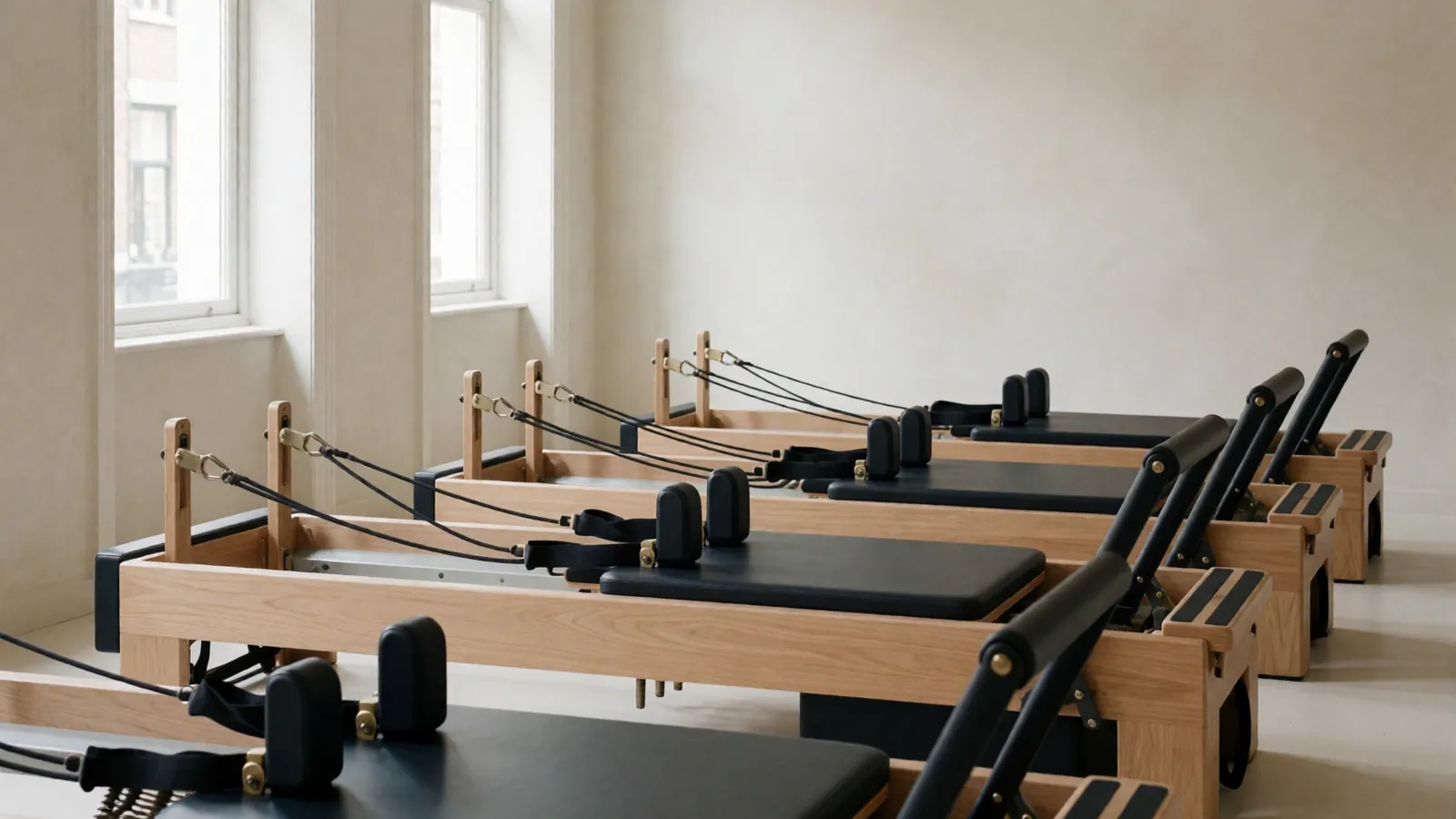
Classes are capped at eight because we own eight reformers. That is the whole reason, and it produces a class where the instructor genuinely watches every person on every exercise — which is what the apparatus requires to be worth using at all.
What reformer pilates trains
Specific qualities, most of which are difficult to train well any other way.
Deep core and pressure management
How the diaphragm, pelvic floor and abdominal wall coordinate under load. This is the foundation of postnatal work and the missing piece behind a great many lower-back complaints.
Control through a full range
The carriage moves if you lose control, which is immediate and honest feedback. You cannot cheat a reformer exercise with momentum the way you can cheat a cable machine.
End-range strength
Producing force at the edges of a joint's range, which is where most injuries occur and where the least training normally happens.
Single-side work
Almost every reformer exercise can be loaded one limb at a time, which finds and fixes left-right asymmetries that a barbell hides very effectively.
Breathing under load
Coordinated with movement rather than held. Most people brace by holding their breath, which works for a heavy single and fails for everything else.
Hip and shoulder mechanics
Trained in positions that a standing gym cannot easily reproduce — supine, side-lying, kneeling — which is why it complements barbell work rather than duplicating it.
Who this suits
Reformer is not a general fitness class and we would rather be clear about what it is for.
Postnatal members
The best available starting point after clearance. Breathing, pressure management and progressive loading, before any barbell goes anywhere near a back. Requires a short private screen with Priya first.
Post-rehab members
Load that can be dialled precisely and support that can be trusted. This is where a great many of our post-rehab cases spend their first two months.
Lifters whose control lags their strength
Very common, and it shows up as a shaky single-leg position or a squat that drifts. Two reformer classes a week for a block usually fixes it.
Anybody with a lower-back history
Trained supine and side-lying, with pressure management coached explicitly. It is frequently the first thing somebody with a cranky back can do without provoking it.
People who want strength work that is not a barbell
A perfectly legitimate preference. Reformer builds real strength — it is simply not maximal strength, and we will say so rather than pretend.
Practical notes for your first class
The reformer looks intimidating and takes about ten minutes to stop being so.
Arrive ten minutes early for your first class
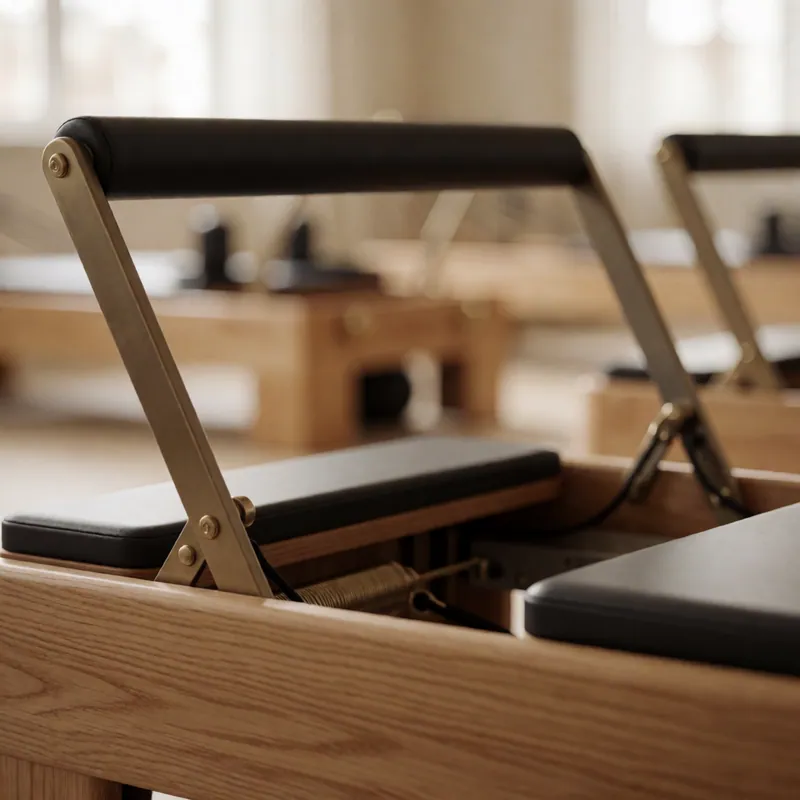
The instructor sets your footbar, your springs and your headrest, and explains the safety chain and the stopper. After the first time it takes thirty seconds.
Wear something reasonably close-fitting
Loose clothing catches in the springs and the straps, which is more of a nuisance than a hazard but is a real nuisance. Grip socks are useful and we sell them at cost; bare feet are also fine.
Expect it to be harder than it looks
The first class is almost always described afterwards as 'that was much harder than I expected'. It is slow, controlled and continuous, which is a different kind of hard from a conditioning class.
Expect specific soreness
Usually the deep abdominals and the adductors, and usually two days later. It fades after the first two or three classes.
Tell the instructor about anything relevant
Pregnancy, recent surgery, a disc history, a hernia repair. Several exercises are modified or removed and Priya would much rather know at the start of the class than halfway through it.
Reformer Pilates in western Queens
Eight reformers, eight people, and spring resistance that can support a beginner or challenge a competitor.
It starts the same way whatever you are here for: ninety minutes with a coach, a movement screen, a handful of baseline numbers, and a written twelve-week programme in your hand at the end of it. The assessment is free, the programme is yours to keep, and there is nothing to sign.
This page is general information, not medical advice. Nothing here is a diagnosis, a treatment plan or a substitute for your own physician, physical therapist or registered dietitian. If you have a cardiac condition, uncontrolled blood pressure, a recent surgery, a current injury, an eating disorder or a pregnancy, speak to your provider before starting or changing a training or nutrition programme — and tell us what they say, because we build around written clearance rather than around what somebody remembers being told. Pain at rest, pain that wakes you at night, worsening symptoms or any neurological symptom need proper clinical assessment first, and we will say so rather than train through them.
Questions
Reformer Pilates — the questions we are asked most
What is the difference between reformer pilates and mat pilates?
The reformer adds spring resistance that can both assist and load a movement, plus a moving carriage that gives constant feedback about your control. Mat pilates uses bodyweight only. The reformer is far more adjustable, which is why it works for somebody in post-rehab and somebody very strong in the same class.
Is reformer pilates a good workout on its own?
It builds real strength, excellent control and useful end-range range of motion. It does not build maximal strength or much cardiovascular fitness, so on its own it is an incomplete programme. The best pattern we see is two reformer classes a week alongside two strength sessions.
Can I do reformer pilates while pregnant or after giving birth?
After birth, with your provider's clearance, it is one of the best available starting points — and we ask for a short private screen with Priya first. During pregnancy, several exercises are modified or removed and we will need your provider's clearance. Tell us either way before you book.
Is it good for lower back pain?
Often, yes, and particularly because much of it is trained supine and side-lying with pressure management coached explicitly. That said, Priya is a licensed physical therapist and will tell you plainly when something needs clinical assessment rather than a class.
How many people are in a class?
Eight, because we have eight reformers. That is not a marketing cap — it is a physical one, and it means the instructor genuinely watches every person on every exercise, which is what the apparatus needs to be worth using.
Do I need special shoes or socks?
Grip socks are useful and we sell them at cost at the desk. Bare feet are also completely fine. What matters more is reasonably close-fitting clothing, because loose fabric catches in the springs and straps.
Will reformer pilates help me lose weight?
Not directly and not much — it burns relatively few calories per session. What it does is build strength, control and range that make everything else in your programme work better. If weight is your goal, the honest levers are nutrition, daily walking and strength training.
I lift heavy. Is this useful for me?
Frequently more useful than for anybody else, because heavy lifting builds strength faster than it builds control, and the gap shows up as a drifting squat or an unstable single-leg position. Two classes a week for a six-week block is usually enough to close it noticeably.
Related
Members usually pair this with
Group Classes
HIIT & Conditioning
Hard, capped at twenty, and programmed in six-week blocks so it actually gets you fitter.
Read more
Group Classes
Indoor Cycling
Twenty-four bikes in a room built for twenty-four, with air handling that actually works.
Read more
Group Classes
Boxing Fitness
Real technique on the bags, no sparring, no contact — conditioning that happens to be a skill.
Read moreFree assessment, free trial week, no contract
Book a free 90-minute assessment
Ninety minutes with a coach, nothing to sign, and a written twelve-week programme you keep whether or not you join. Every membership is month to month with no initiation fee and no notice period, and the trial week is free.