Not sure where to start? The ninety-minute assessment is free, involves nothing to sign, and ends with a written twelve-week programme you keep whether or not you join. Call 000-000-0000
Indoor cycling has almost no joint impact, which makes it the safest hard conditioning we offer. You can work at an effort that would be reckless on a treadmill for somebody deconditioned, heavy or managing a lower-limb injury, and you can stop instantly without decelerating. For a great many members it is where their fitness is actually built.
Two unglamorous things decide whether a cycling studio is any good. The first is setup: a saddle at the wrong height causes essentially every knee complaint anybody has ever had about cycling, and the correct height is higher than most people set it. Your first ride here includes a coached setup, and the numbers go on your record so any coach can reset your bike in ten seconds.
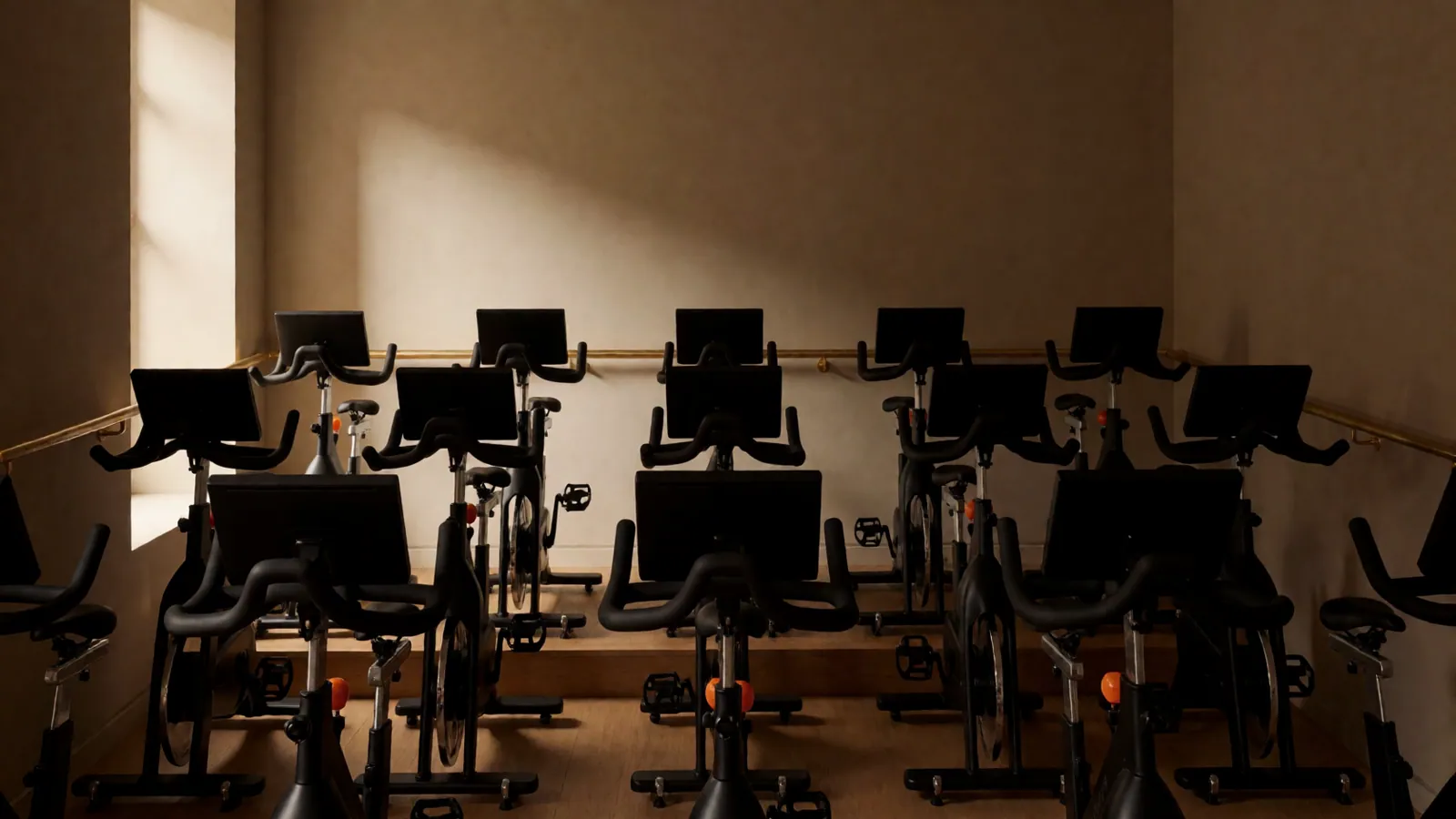
The second is air. Twenty-four people working hard in a small room is a genuine ventilation problem, and most studios solve it with a fan pointed at the front row. Studio Two has a system sized for the room rather than for the building, which is the entire reason people describe our classes as hard rather than as unbearable.
Getting your setup right
Ninety seconds, once, and then it is on your record forever. Do not skip this.
Saddle height
With the pedal at the bottom, your knee should retain a slight bend — roughly twenty-five to thirty-five degrees. Almost everybody sets this too low, and too low is what makes knees ache. A coach sets yours on your first ride.
Saddle fore and aft
With the cranks level, the front knee should sit roughly over the pedal axle. This is what stops you sliding forward and taking the load through your hands and shoulders.
Handlebar height
Higher is not weaker — it is what lets a stiff back sit comfortably for forty-five minutes. New riders start high and drop it over months as their hips and thoracic spine allow.
Cleats or trainers
Both work. Cycling shoes clip in and are more efficient; ordinary trainers in the cages are perfectly adequate and are what most people use. Nobody needs to buy anything to take a class here.
Resistance, honestly set
The single most common way to waste a class is spinning at high cadence against almost no resistance. It looks fast and trains very little. Your coach will tell you what a real hill should feel like, and it is heavier than you think.
The rides we run
Programmed in blocks, like everything else here, so the intervals in week five are harder than the intervals in week one.
Endurance ride, 45 minutes
Sustained moderate work with long efforts. The least glamorous class on the timetable and the one that most improves your actual aerobic capacity.
Interval ride, 45 minutes
Structured hard efforts with defined recoveries. The work-to-rest ratio changes across the block, so this is a different class in week one and week five.
Climb ride, 45 minutes
Heavy resistance, low cadence, seated and standing. Closest thing on a bike to strength work, and the one that most improves people's ability to hold a hard effort.
Express ride, 35 minutes
Lunchtime. Denser, shorter warm-up, straight into the work. Popular enough that it books out first.
Weekend ride, 45 minutes
Saturday and Sunday mornings, a little more forgiving, and the class most new riders start with.
Who indoor cycling suits particularly well
It is not simply a cardio option. For several groups it is clearly the best one available.
Anybody managing a knee, ankle or shin
Almost no impact, an effort you control completely, and instant stopping. This is the class Priya sends most post-rehab members to for their conditioning.
Deconditioned or heavier members
You can reach a genuinely high heart rate without asking your joints to absorb bodyweight impact repeatedly. It is the safest way for somebody starting from a low base to work hard.
Runners in the winter
61st Street in January is ice. A structured interval ride maintains and often improves aerobic fitness through the months when running outside is a bad idea.
People who dislike group fitness
The lights are low, nobody can see you, you control your own resistance, and there is no choreography to learn. Several of our most committed riders started with 'I hate classes'.
Lifters who need conditioning that does not interfere
Cycling produces far less muscle damage than running, so it competes much less with heavy lifting later in the week. This is a real programming advantage and it is why we recommend it over running to most of our strength members.
Indoor Cycling in western Queens
Twenty-four bikes in a room built for twenty-four, with air handling that actually works.
It starts the same way whatever you are here for: ninety minutes with a coach, a movement screen, a handful of baseline numbers, and a written twelve-week programme in your hand at the end of it. The assessment is free, the programme is yours to keep, and there is nothing to sign.
Questions
Indoor Cycling — the questions we are asked most
Do I need cycling shoes for a spin class?
No. Every bike takes ordinary trainers in the cages and most people ride that way indefinitely. Clip-in shoes are slightly more efficient and make it easier to pull as well as push, so plenty of regular riders eventually buy a pair — but nobody needs to buy anything to take a class here.
Is indoor cycling good for weight loss?
It burns a substantial number of calories per session and improves cardiovascular fitness quickly, which helps. Body composition, though, is driven far more by food, sleep and daily walking than by any single class. The most effective pattern we see is two rides a week alongside two strength sessions and a nutrition conversation.
Will spinning make my legs bulky?
No. Cycling is endurance work, not hypertrophy work — the resistance is nowhere near heavy enough and the repetitions are in the thousands. If you want bigger legs, the barbell floor is where that happens, and it takes years of deliberate effort.
My knees hurt when I cycle. What is wrong?
Almost certainly your saddle height, and almost certainly it is too low. It is the cause of the overwhelming majority of knee complaints in cycling and it takes ninety seconds to fix. Ask any coach for a setup before your next ride — it is free and the numbers go on your record.
How hard are the classes?
As hard as you set your own resistance, which is the honest answer. The coach calls efforts and cadences; you choose the load. A first-time rider and a competitive cyclist can take the same class and both be appropriately challenged, which is not true of most group formats.
Is the room dark and loud?
Dim rather than dark, with warm indirect lighting rather than club lighting, and the music sits under the coaching rather than over it. We had this conversation with members early and settled it firmly: you should be able to hear an instruction without it being shouted.
How early should I arrive for my first class?
Ten minutes. That is enough for a coach to set your bike properly and show you the resistance dial, which is the difference between a good first ride and a sore-kneed one. After that you can walk in two minutes before and be fine.
Can I book a bike in a specific spot?
Yes, bikes are numbered in the app and you choose your own. Most regulars ride the same bike every week. New riders are welcome anywhere, though the back row is a perfectly respectable place to start and nobody will notice.
Related
Members usually pair this with
Group Classes
HIIT & Conditioning
Hard, capped at twenty, and programmed in six-week blocks so it actually gets you fitter.
Read more
Group Classes
Boxing Fitness
Real technique on the bags, no sparring, no contact — conditioning that happens to be a skill.
Read more
Group Classes
Yoga & Mobility
A quiet room with no mirrors, aimed at the ranges of motion your training and your desk are taking away.
Read moreFree assessment, free trial week, no contract
Book a free 90-minute assessment
Ninety minutes with a coach, nothing to sign, and a written twelve-week programme you keep whether or not you join. Every membership is month to month with no initiation fee and no notice period, and the trial week is free.