Not sure where to start? The ninety-minute assessment is free, involves nothing to sign, and ends with a written twelve-week programme you keep whether or not you join. Call 000-000-0000
The muscle and strength losses that come with age are real and they are also substantially reversible. Adults in their seventies and eighties gain strength from resistance training at rates that surprise people who have not read the literature, and the practical consequences — standing up from a chair, carrying shopping, catching yourself after a stumble — arrive within weeks rather than years.
What does not work is the standard offering: a stationary bike, some light dumbbells, and a class that is essentially a warm-up repeated for forty-five minutes. It is safe, and it also produces almost no adaptation, which is why so many older adults conclude that exercise does not do much. Load is the active ingredient. Coaching is what makes load safe.
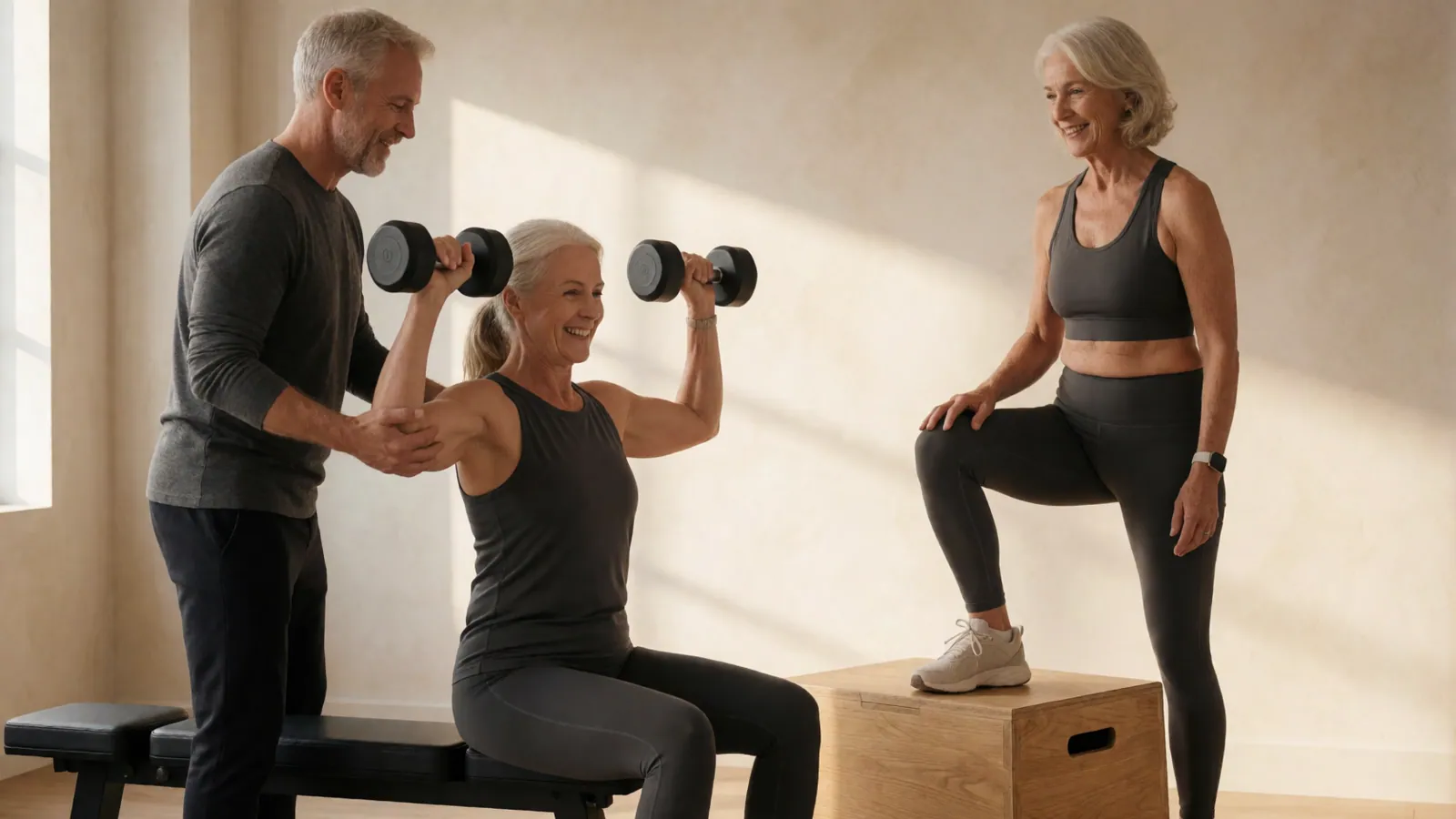
So we screen carefully, we load conservatively but genuinely, and we measure the specific things that predict independence rather than the things that are easy to photograph. Tomasz runs Senior Strength twice a week; Priya reviews anybody with a joint replacement, a spinal condition or a fall history before they start.
What we actually train, and why
Each of these was chosen because it predicts something that matters outside this building.
Grip strength
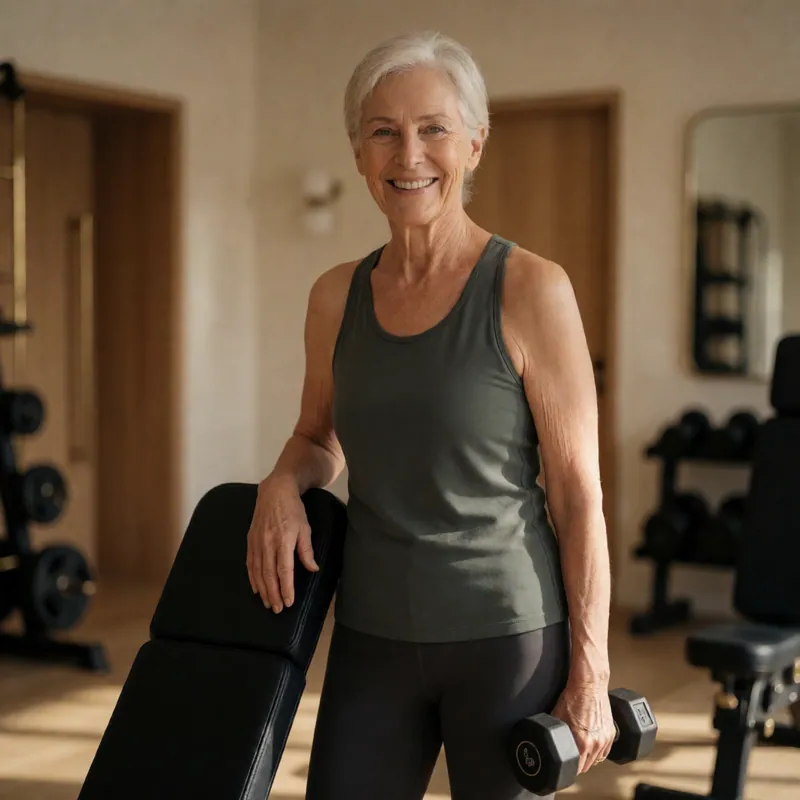
One of the most reliable single predictors of general health and mortality in older adults. It is also easy to train — carries, holds and heavy dumbbell work — and it improves quickly, which is good for morale in month one.
Getting out of a chair, fast
The chair-stand test measures leg power rather than leg strength, and power fades faster than strength with age. We train it directly with box squats, step-ups and deliberately quick concentric work.
Single-leg balance
Almost every fall happens on one leg. Balance is trainable at any age and it responds within weeks. We measure it at assessment and at every twelve-week retest.
Getting up off the floor
The thing that decides whether a fall is an embarrassment or a hospital admission. Practised deliberately, in stages, with a mat and no dignity required.
Carrying things
Loaded carries train grip, trunk, hips and balance simultaneously, and they translate directly into shopping bags, grandchildren and suitcases. Pound for pound the most useful exercise we coach.
Bone loading
Bone responds to load and to impact. Where it is appropriate and cleared, we include weight-bearing work and gentle impact rather than avoiding both on principle.
How we make it safe without making it useless
The line between careful and pointless is real, and most programmes for older adults land on the wrong side of it.
Clearance where it is genuinely indicated
Cardiac history, uncontrolled blood pressure, recent surgery, osteoporosis diagnosis or a fall in the last year — we ask for written clearance from your provider. This is not a formality and we do not waive it.
Load, added slowly and actually added
Five pounds every two or three weeks is a slow progression that compounds into something transformative over a year. The mistake is not adding load; the mistake is starting too heavy and never adding any.
Machines and free weights, chosen deliberately
Machines are useful for anybody with a balance concern or an early-stage joint issue. Free weights train balance and coordination that machines cannot. Most of our older members use both, and the ratio changes as they improve.
Blood pressure respected
We avoid prolonged breath-holding under load, keep the head above the heart where there is a concern, and know which medications blunt heart-rate response so we do not use heart rate as a gauge for somebody on a beta blocker.
Joint replacements worked around, in writing
Hip and knee replacements have specific restrictions and they differ by surgeon and by approach. We work from your surgeon's guidance rather than from a general rule, and Priya reads it before you start.
What the first year usually looks like
Composite of the pattern we see most often. Individual results vary enormously, and the people who improve most are almost always the people who simply keep turning up.
Months one and two
Learning the movements at very light loads, and the first improvements in balance and confidence. Almost nobody is sore after the first fortnight. Twice a week is plenty.
Months three to six
Load starts climbing meaningfully. Chair-stand counts improve first and are usually the most motivating number on the retest sheet. Grip follows. This is where people start noticing things outside the gym.
Months seven to twelve
Genuine strength. Members who arrived unable to get off the floor unaided are commonly doing it comfortably by now, and shopping, stairs and grandchildren stop being topics of conversation.
Year two and beyond
Maintenance is not the right word — most of our long-term older members are still getting stronger in year three. Two days a week, indefinitely, is the whole prescription.
Senior Fitness in western Queens
Strength training for adults over sixty, aimed squarely at staying independent rather than at looking busy.
It starts the same way whatever you are here for: ninety minutes with a coach, a movement screen, a handful of baseline numbers, and a written twelve-week programme in your hand at the end of it. The assessment is free, the programme is yours to keep, and there is nothing to sign.
This page is general information, not medical advice. Nothing here is a diagnosis, a treatment plan or a substitute for your own physician, physical therapist or registered dietitian. If you have a cardiac condition, uncontrolled blood pressure, a recent surgery, a current injury, an eating disorder or a pregnancy, speak to your provider before starting or changing a training or nutrition programme — and tell us what they say, because we build around written clearance rather than around what somebody remembers being told. Pain at rest, pain that wakes you at night, worsening symptoms or any neurological symptom need proper clinical assessment first, and we will say so rather than train through them.
Questions
Senior Fitness — the questions we are asked most
Is weight training safe at 70 or 80?
Coached and progressively loaded, it is one of the safest and most beneficial things an older adult can do — the injury rate in supervised resistance training for older people is very low, and the risks of not training are considerably higher. What is not safe is unsupervised heavy training with no screening, which is why we screen everybody and ask for medical clearance where the history indicates it.
I have had a hip replacement. Can I still train?
Almost certainly, and a great many of our members have. Restrictions differ by surgeon and by surgical approach, so we work from your surgeon's written guidance rather than from a general rule. Priya reviews every joint replacement before the first session and builds the programme inside the stated limits.
How often should older adults strength train?
Two sessions a week is enough to produce substantial gains and is what we start almost everybody on. Three is better once the habit is established. More than three is rarely necessary and often gets in the way of recovery, which matters more with age, not less.
Will I need a doctor's note?
Sometimes. We ask for written clearance where the health history shows a cardiac condition, uncontrolled blood pressure, a recent surgery, an osteoporosis diagnosis or a fall within the last year. Otherwise the assessment is enough. We will tell you which applies at the end of the ninety minutes.
Is there a class specifically for older adults?
Senior Strength runs Tuesday and Thursday mornings, capped at twelve, and is included in every membership. It is not a gentler version of another class — it is a strength programme with the pacing and the coaching cues adjusted, and members progress in it the same way anybody else does.
What if I have never exercised in my life?
Then you are in the majority of the people who join this group, and you will improve faster than the people who have. The first month is deliberately easy. Nobody starts with a barbell and nobody is asked to do anything they have not been shown twice.
Can I train with my spouse?
Yes, and it works well — semi-private is $60 each for two people with one coach, and Senior Strength has several couples in it. Attendance is measurably better among people who come with somebody, which is worth knowing.
Will this help my balance and stop me falling?
Balance and leg power are both trainable at any age and both respond within weeks. We measure single-leg balance and a chair-stand count at assessment and at every retest, so you can see it change. It is the improvement our older members most often mention first.
Related
Members usually pair this with
Coaching
Personal Training
One coach, one written programme, and somebody whose job it is to notice whether it is working.
Read more
Coaching
Small-Group Training
Six people, one coach, one programme — the coaching of a private session at a fraction of the price.
Read more
Coaching
Online Coaching
A written programme, video form review and a real coach — for people who train somewhere else, or everywhere.
Read moreFree assessment, free trial week, no contract
Book a free 90-minute assessment
Ninety minutes with a coach, nothing to sign, and a written twelve-week programme you keep whether or not you join. Every membership is month to month with no initiation fee and no notice period, and the trial week is free.