Not sure where to start? The ninety-minute assessment is free, involves nothing to sign, and ends with a written twelve-week programme you keep whether or not you join. Call 000-000-0000
Most conditioning classes are improvised. A different hard workout every day, chosen for novelty, with no relationship between Tuesday and the following Tuesday. It feels productive because it is exhausting, and for about eight weeks it genuinely is — then nothing changes for a year and people conclude they have plateaued when in fact they were never on a programme.
Nadia writes ours in six-week blocks. The intervals in week five are the same intervals as week one at a measurably higher output, there is a planned easier week, and you can see your own numbers move because we ask you to record them. That is the entire difference, and it is not a small one.
It is also genuinely capped at twenty. Studio One holds twenty people who can each move a medicine ball without hitting anybody, and that is the number we run. A full class runs a waitlist rather than opening a twenty-first spot, which occasionally annoys people and is not going to change.

What a conditioning class looks like
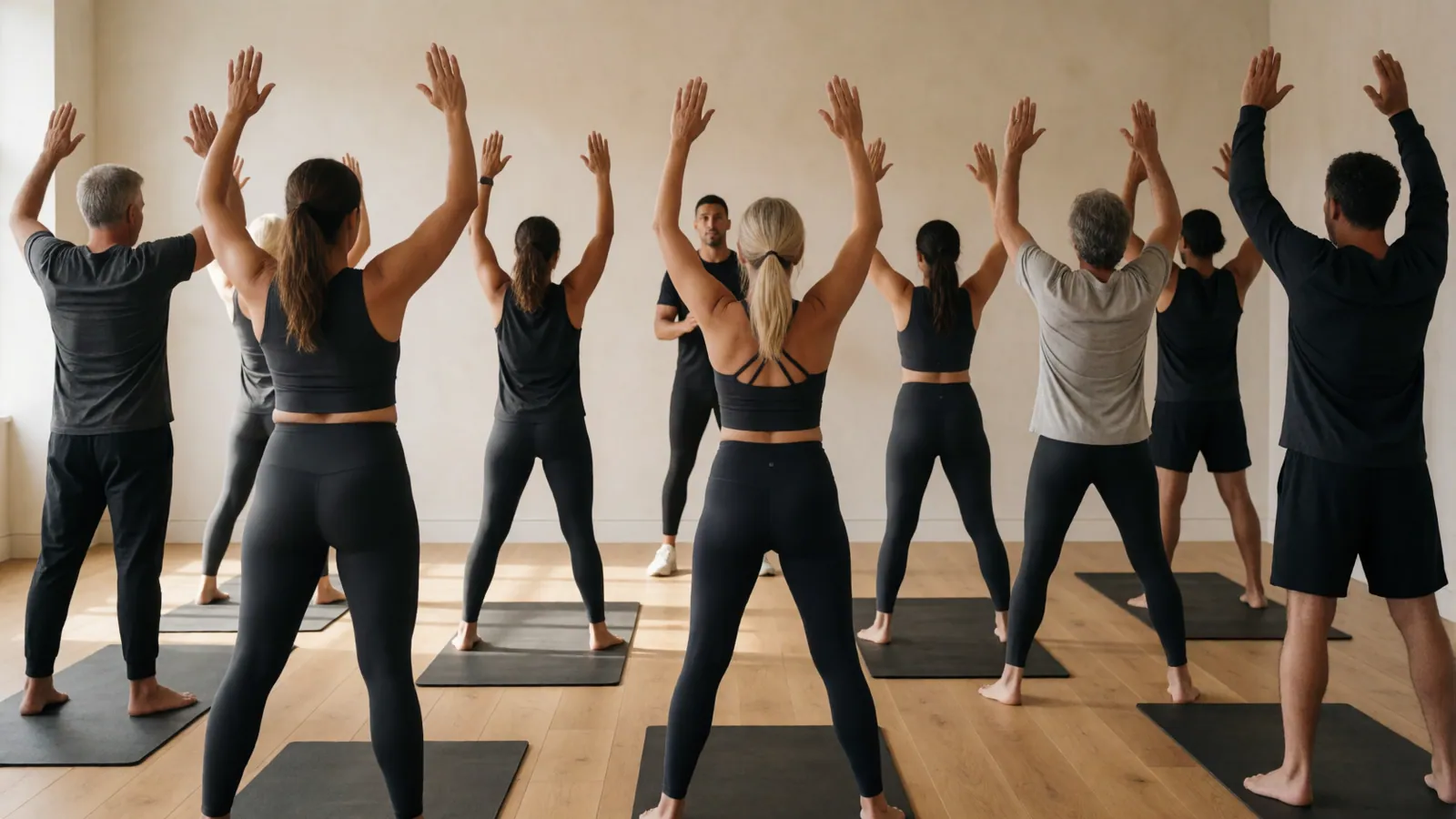
Forty-five minutes, twenty people, one coach and no queue for equipment.
Ten minutes of real preparation
Not a token warm-up. Progressive movement through the patterns the session uses, at increasing intensity, so the first hard interval is not also the first time your hips have moved that day.
A strength or power component
Kettlebell work, carries, med-ball throws or loaded step-ups, done fresh while you can still produce force. Putting the strength element after the conditioning is the most common design mistake in group fitness.
The interval block
The heart of the session. Work-to-rest ratios chosen for the block's intention rather than for how hard it looks — thirty seconds on and thirty off trains something completely different from four minutes on and two off, and both belong in a year.
A cool-down that is not optional
Five minutes of breathing down and easy movement. It is the part everybody wants to skip and the part that most affects how you feel in the class two days later.
Numbers you record
Rounds, reps, distance or watts, written on your own card. In week six you look at week one. This is the single most motivating thing in the class and it costs nothing.
The formats we run
Different intentions, deliberately. If every class is the same intensity, the programme has no shape.
Conditioning, 45 minutes
The standard class. Mixed-modal work with a strength element, run in six-week blocks. Five times a week on the timetable plus Saturday and Sunday mornings.
Express Conditioning, 35 minutes
Lunchtime, denser, no strength component. Built for people with a real hour including changing and a shower, and popular with the office crowd from Queens Boulevard.
Long intervals
Appears in blocks two and five. Four to six minutes of sustained work with full recoveries. Harder in a different way and the one that most improves aerobic capacity.
Sled and carry sessions
Run on the turf when the block calls for it. Almost no eccentric loading, so the effort is enormous and the soreness afterwards is minimal — very useful for anybody managing a joint.
The deliberately easier week
Roughly every sixth week, everything drops by a third. People routinely set personal bests the week after it, which is exactly the point.
Making high-intensity training actually work
The mistakes that turn an effective method into an exhausting hobby.
Two or three a week is the dose
Not five, and not daily. High-intensity work is a stimulus that requires recovery to become an adaptation. Five hard sessions a week produce a fit, permanently tired person who stops improving.
Intensity has to be genuinely high
The reason it works is the intensity. A class where everybody moves continuously at a moderate effort for forty-five minutes is a long moderate workout wearing an interval costume, and it produces moderate results.
It is not a substitute for strength training
Conditioning classes build very little strength and essentially no maximal strength. The best results we see come from members who lift twice a week and condition twice a week, not from members who do four classes.
Scaling is not failure
Every movement has three versions and the coach will give you one. The person doing the easiest version at the right intensity is training better than the person doing the hardest version badly, and this is true at every level.
Sleep decides whether it works
The adaptation happens while you are asleep. Six hours a night and four hard classes a week is a combination that reliably produces injury or illness within about two months.
HIIT & Conditioning in western Queens
Hard, capped at twenty, and programmed in six-week blocks so it actually gets you fitter.
It starts the same way whatever you are here for: ninety minutes with a coach, a movement screen, a handful of baseline numbers, and a written twelve-week programme in your hand at the end of it. The assessment is free, the programme is yours to keep, and there is nothing to sign.

Questions
HIIT & Conditioning — the questions we are asked most
How often should I do HIIT?
Two or three sessions a week is the effective dose for almost everybody. The adaptation comes from recovering between hard efforts, so five hard classes a week produces a permanently tired person who has stopped improving. Most of our best results come from members who condition twice a week and lift twice a week.
Are your classes suitable for beginners?
Yes. Every movement has three versions and the coach gives you the right one — nobody is left to guess. What we ask is that you tell the coach it is your first class, because they will then find you twice during the session rather than not at all.
How big are the classes?
Conditioning and boxing are capped at twenty, cycling at twenty-four, yoga and mobility at eighteen, and reformer pilates at eight. When a class is full it is full — we run a waitlist rather than adding people to a room, and that policy is not flexible.
Do I need to book?
Yes, through the member app. Coached members book fourteen days ahead and everyone else seven. Cancel more than two hours before with no penalty. Three no-shows inside a month costs you priority booking for the following month, because a booked spot in a capped class is one somebody else could have used.
What is the difference between the 45 and 35-minute classes?
The 35-minute Express format drops the strength component and shortens the preparation, so it is denser and slightly harder per minute. It exists for people with a genuine lunch hour including changing and showering. If you have the time, take the 45.
Will HIIT help me lose weight?
It helps, and it is not the main lever. Conditioning classes burn a meaningful number of calories and improve cardiovascular fitness substantially, but body composition is driven far more by what you eat, how much you sleep and how much you walk on the other days. Elena's page on nutrition coaching is more honest about this than most gyms are.
Can I do a class if I have a knee or back problem?
Usually yes, with modifications, and we would rather know than not. Tell the coach before the class starts — every session can be scaled to remove impact, jumping or loaded flexion. If it is a current injury under treatment, book the free assessment first so Priya can look at it.
Is my first class free?
Yes, any class on the timetable, once, whether or not you are a member. Book it through the desk or the contact form. There is no sales conversation attached to it.
Related
Members usually pair this with

Group Classes
Indoor Cycling
Twenty-four bikes in a room built for twenty-four, with air handling that actually works.
Read more
Group Classes
Boxing Fitness
Real technique on the bags, no sparring, no contact — conditioning that happens to be a skill.
Read more
Group Classes
Yoga & Mobility
A quiet room with no mirrors, aimed at the ranges of motion your training and your desk are taking away.
Read moreFree assessment, free trial week, no contract
Book a free 90-minute assessment
Ninety minutes with a coach, nothing to sign, and a written twelve-week programme you keep whether or not you join. Every membership is month to month with no initiation fee and no notice period, and the trial week is free.